History of the Mariastichting
The Mariastichting was a well-known nineteenth-century hospital in the south of Haarlem. In 2004 it left its site, freeing up a remarkable spot between the Spaarne and the Haarlemmerhout for a new purpose.
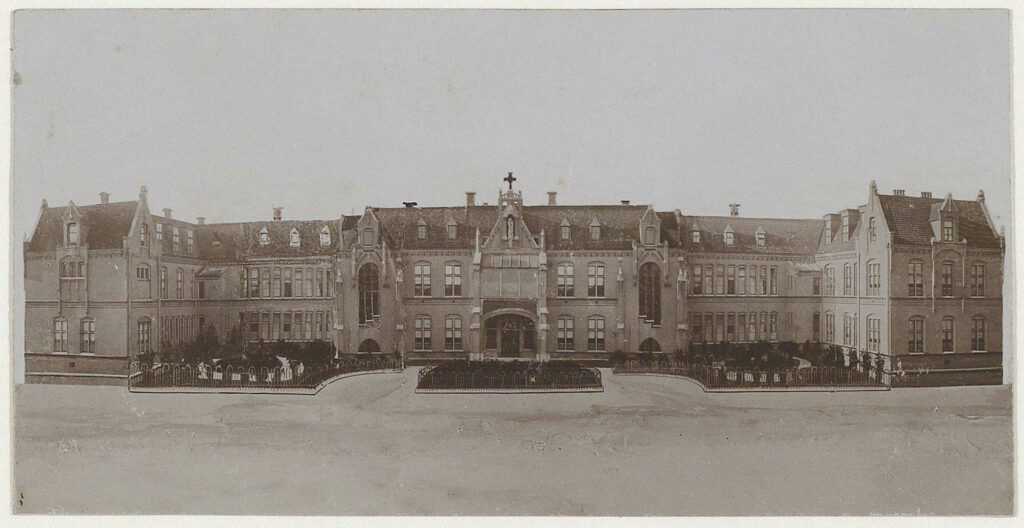
The Mariastichting acted as commissioning party and drew up and published a brief calling for 378 homes, 8,000 to 10,000 square metres of office space and an underground car park with 582 spaces. One firm requirement was that the monumental nineteenth-century main building on the Kamperlaan had to be preserved.
The ‘Schatkamer aan het Spaarne’ (Treasury on the Spaarne), a plan developed in collaboration with Bouwfonds Property Development and Faro architects, was selected from the three plans that were submitted.
The starting point for the design was the unique location: on the water, close to the green Haarlemmerhout and the historic city. The plan made the most of these qualities and anchored the new neighbourhood firmly in its surroundings.
History was not erased in the process. Several defining buildings, such as a historic chapel and a number of houses along the Kleine Houtweg, were preserved. So too was the main building of the Mariastichting on the Kamperlaan, which was converted to house apartments. To deliver the required programme, a high density of 150 homes per hectare was necessary. Even so, the construction of an underground car park made a park-like setting possible. A twelve-metre-wide avenue connecting the Spaarne with the Haarlemmerhout forms the main axis.
Another distinctive feature of the plan is the Kloosterhof, a green space with the old hospital chapel as its historic centrepiece. The spatial motif of this courtyard has been carried through into the rest of the neighbourhood. In the tradition of Haarlem’s characteristic hofjes (almshouse courtyards), intimacy and openness are combined. Around the Kloosterhof stand free-standing pavilions containing apartments. The buildings match the height of the nineteenth-century main building and are composed of brickwork, timber and glass. On the west side of the Kloosterhof, the 1971 hospital tower block was replaced by a slender residential tower of twenty storeys, a landmark in the Haarlem skyline. This tower is called De Hoge Hout.
The offices were planned for the north-west corner of the area, partly as new construction and partly in two monumental villas on the Kleine Houtweg. For various reasons, however, these offices have never been developed and the plot intended for them still lies vacant. The so-called Kloostertuin in the south-west corner of the area provides space for family homes with gardens and a playground in an informal setting. On the bank of the Spaarne, the connection between city and river has been restored. The four apartment buildings that flank the water here were each given their own architectural treatment, with the extensive use of brick echoing Haarlem’s historic architecture. The space between the residential blocks gives the neighbourhood views of the water, and a promenade lets you enjoy the Spaarne to the full.
Mariastichting street and apartment names
The street names are linked to Haarlem’s distant past and refer, among other things, to a number of country estates that once stood along the Spaarne.
The estate of Jan Willemsz, brewer and owner of the De Leystar brewery, for example, gave its name to the De Leystarlaan.
The Bellevue estate, of which the present-day tea pavilion still remains, bordered the Kleine Houtweg and gave its name to the Bellevuelaan.
There were also the following estates: Oosterhout, Spaar en Hout, Zorgvrij, Ruhe Orth, Vliedzorg, Buitenrust and Klein Rustenburg.
The Spaarne apartments are named after famous European waterside cities, such as Lausanne, Lisbon, Verona and Florence.
Benedictushof is named after Benedict of Nursia. He founded a convent in 529, and in 1899 the Mariastichting was one of the first Catholic hospitals for women.
The Kloostertuin apartments were given historic names related to the Catholic faith, such as Herkenrode, Ignatiushove, Camillus, Cadiz Evora, Marienkroon and Bonaventura.